How to Solve Jigsaw Puzzles Faster: Tips That Actually Work
Practical tips for solving jigsaw puzzles faster — sorting, edges, color and shape grouping, lighting, and the habits competitive puzzlers actually use.
4 min read
In this Article
There's a big gap between someone poking at a pile of pieces for hours and someone who finishes a 1,000-piece puzzle in an afternoon. It's not really about being smarter — it's mostly about having a system. Here's what actually speeds you up, minus the fluff.
Sort before you build
The instinct is to dive straight in and start matching pieces. Resist it. Spending the first ten minutes sorting saves you an hour of hunting later.
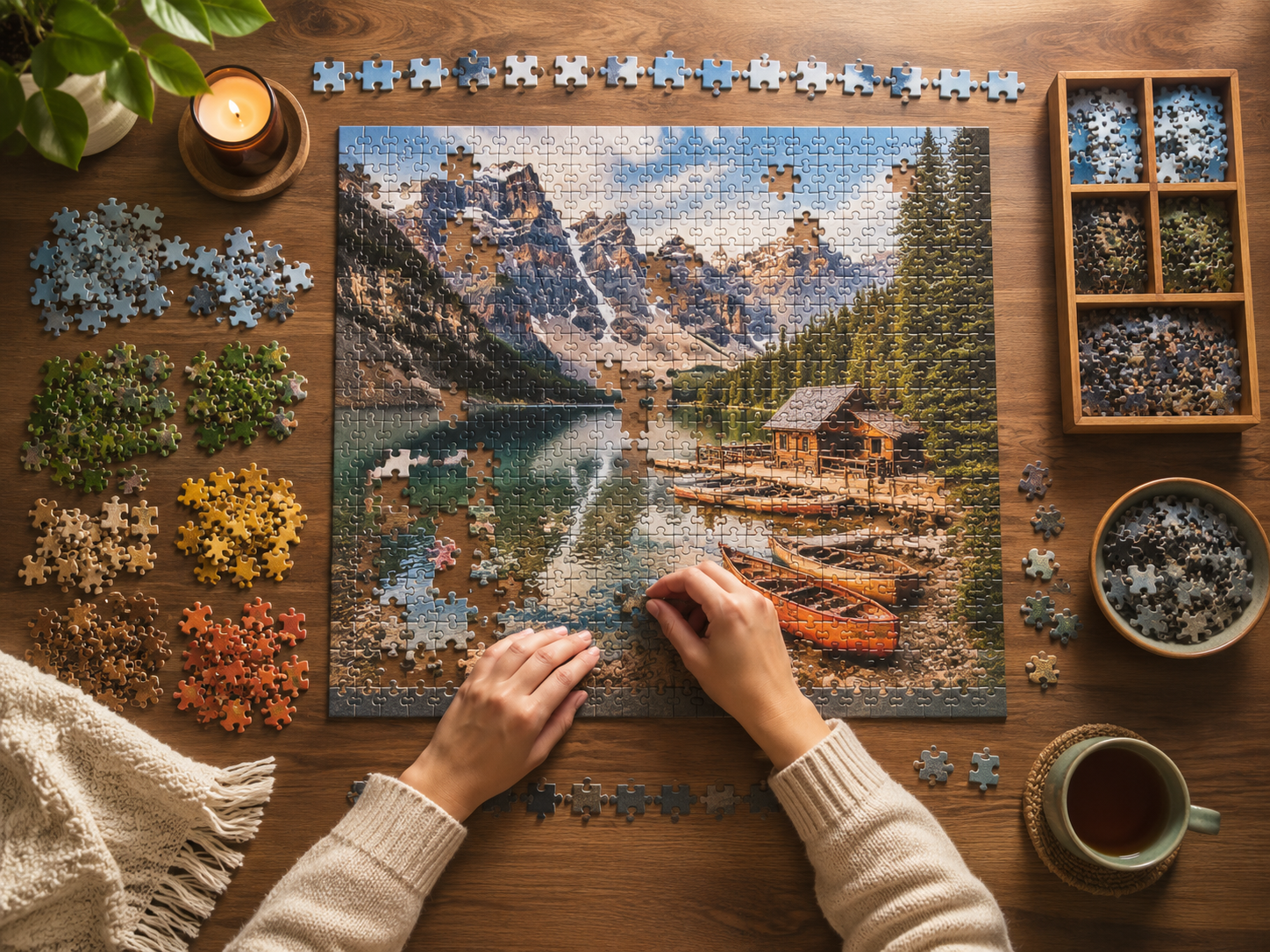
At minimum, separate the edge pieces from the rest. After that, sort the middle pieces into rough groups — by color, by obvious feature (sky, grass, a face, a window). You're not looking for perfection, just enough order that when you need a dark green piece you're searching through forty pieces instead of four hundred.
Do the edges first
Building the border first gives you a frame to work inside and tells you exactly how big the finished puzzle is. It's the one piece of advice every puzzler agrees on, and for a reason — it turns an open-ended problem into a bounded one.
Work in sections, not all over
Once the border's done, pick a section with a distinct feature and finish it before moving on. A bright red barn, a person's face, a patch of flowers — anything that stands out from the rest. Completing recognizable chunks gives you anchor points, and the boring areas (looking at you, blue sky) get easier once everything around them is filled in.
Learn to read piece shapes
This is the trick that separates fast solvers from slow ones. Color gets you into the right neighborhood; shape finds the exact piece.
When you've got a gap, look at what it needs: tabs on which sides, blanks on which sides. "I need a piece with tabs on the left and bottom, blanks on top and right." That single habit narrows your search from hundreds of pieces to a handful.
Save the hard parts for last
Large areas of one color — sky, water, a plain wall — are the worst. Don't fight them early. Build everything else first, and by the time you come back, those sections are smaller, more bounded, and you can lean on shape alone to place the pieces.
Get the lighting and surface right
Two boring fixes that make a real difference. Good, bright, even light (daylight bulbs beat warm yellow ones) makes color differences obvious. And a large, stable surface where you can spread everything out means less time digging through a crowded pile.
Take breaks
Staring at the same section for twenty minutes is how you miss the piece that's right in front of you. Step away, let your eyes reset, come back. Fresh eyes find pieces that tired eyes walk right past.
Practicing online
One underrated way to build speed is doing lots of small puzzles. A 1,000-piece puzzle is a concert performance; a quick 24- or 50-piece puzzle is practicing scales. You're drilling the same skills — color matching, shape reading, systematic searching — just faster and more often.
Online puzzles are good for this because you can set the piece count, run a small one in a few minutes, and try the same image at a harder size once it feels easy. A couple of things carry over with a twist:
- Rotation is deliberate. On a screen you have to rotate pieces on purpose. Forgetting to rotate is the number one reason a piece "won't fit" when it actually does.
- No lost pieces, no cleanup. You can stop mid-puzzle and the board is exactly where you left it.
If you want to drill, pick a low piece count and run a few — then bump it up once you're quick.
FAQ
What's the fastest way to start a jigsaw puzzle?
Sort first, then build the edges. Sorting edge pieces and grouping the rest by color before you assemble anything saves far more time than it costs.
Should I sort by color or shape?
Both, in order. Color gets you to the right group; shape finds the exact piece within it. Reading the tabs and blanks of the gap you're filling is the biggest speed-up most people are missing.
How long should a 1,000-piece puzzle take?
It varies a lot, but several hours is normal — averages land around nine hours spread across sittings. Breaks help more than pushing through.
Do these tips work for online puzzles too?
Yes. Sorting, edges-first, and section-building all apply. The main difference is you rotate pieces deliberately on a screen, and small online puzzles are a great way to practice the skills quickly.
Try It
Knowing the tips is one thing; the speed comes from reps.