Online Jigsaw Puzzles vs Physical Puzzles: When to Choose Which
An honest comparison of online and physical jigsaw puzzles — cost, experience, social value, and the specific moments where one clearly beats the other. From the people who make both.
11 min read
In this Article
We make both. We run a website where people play jigsaw puzzles in their browser, and we also let users order a physical cardboard puzzle of whatever they played online. That gives us a strange but useful vantage point: we watch the same people choose between digital and physical, sometimes within the same session. So this comparison isn't theoretical.
If you've been wondering which one is actually "better" — they're not the same product. They're two ways to do something that looks the same, and they serve different needs.
At a glance
| Online jigsaw puzzles | Physical jigsaw puzzles | |
|---|---|---|
| Cost | Free to ~$10/month on many paid plans | $15–60 per puzzle |
| Setup time | 5 seconds | 10–30 minutes (find pieces, sort edges) |
| Pieces you can lose | Zero | Nonzero, ask anyone with a dog |
| Pause and resume | Yes, instantly | Yes, but only if your table can stay covered |
| Table space required | None | 0.5–1.5 m² depending on piece count |
| Tactile experience | None | The whole point, for many people |
| Social play | Possible via multiplayer (some sites) | Excellent — the classic kitchen-table experience |
| Screen time | Adds to it | Replaces it |
| Final artifact | None | A finished puzzle you can frame, glue, or rebox |
| Variety per dollar | Effectively unlimited | One puzzle per purchase |
| Available pieces / sizes | 9 to 1,000+, instant switch | Whatever you bought |
| AI-stylized versions | Yes (some sites) | Possible if you order one |
| Carbon footprint | Minimal | Manufacturing + shipping + eventual disposal |
| Best for | Trying photos, daily play, travel, low commitment | Gifts, mementos, deep focus, away-from-screen time |
Where online puzzles genuinely win
You can try a photo before committing. This is the single biggest practical advantage. If you have a photo and you're not sure whether it'll make a good puzzle, play it online first. Twenty seconds of upload, two minutes of playing, and you'll know whether the colors and composition actually work as a puzzle. If they do, order the physical. If they don't, try a different photo. With physical puzzles you only find out after the box arrives.
Variety is free. A subscription to a puzzle site for $5–10 a month gives you access to hundreds or thousands of puzzles, plus your own uploads, plus AI-stylized versions of your photos. That same money buys you one physical puzzle every month or two.
No setup or cleanup. A spare half-hour after work, no table available, no inclination to find one — open browser, play puzzle, close browser. Physical puzzles don't compete here. The friction of getting a physical puzzle out of its box is real.
You can play on a train, a plane, in bed. Anywhere with a screen. Many people do their puzzling during commute time precisely because it's tolerable on a phone. Physical puzzles need a dedicated, flat surface.
No lost pieces, ever. The single most universal complaint about physical puzzles is that some percentage of them end up with a missing piece by the time you finish. Online puzzles have eliminated this category of grief.
Difficulty changes instantly. Online, you can change a 300-piece puzzle to 500 with one click. Or to 100 if you're tired. Or to a different mode entirely. Physical puzzles are fixed at whatever count you bought.
It's better for travel and small living spaces. If you live in a studio apartment or rent a small bedroom, physical puzzles are aspirational; online puzzles are realistic.
Where physical puzzles genuinely win
The tactile experience is the whole point. This isn't a small thing. The physical sensation of handling a cardboard piece, feeling its edges, fitting it into place — for a significant fraction of puzzlers, that's why they puzzle. Take it away and you've taken away the activity, not just changed the medium. Online puzzles are a different game that happens to share rules.
Time away from screens. Many people start puzzling specifically to get an hour without staring at a phone or computer. If you're trying to read more, sleep better, reduce digital fatigue, or just be present at home — an online puzzle defeats the purpose. A physical puzzle solves it.
Group activity around a table. Three people standing around a kitchen island, slowly assembling something over the course of a Sunday afternoon, talking about everything and nothing — that experience cannot be replicated digitally. Online multiplayer exists, but it's a side-by-side video call, not a shared physical space.
You end up with something. A completed physical puzzle is an object. You can glue it, frame it, give it as a gift, keep it in a drawer for a year and rebuild it. There's a permanence and a slight sense of accomplishment that online puzzles can't deliver. When you finish an online puzzle, you close a tab.
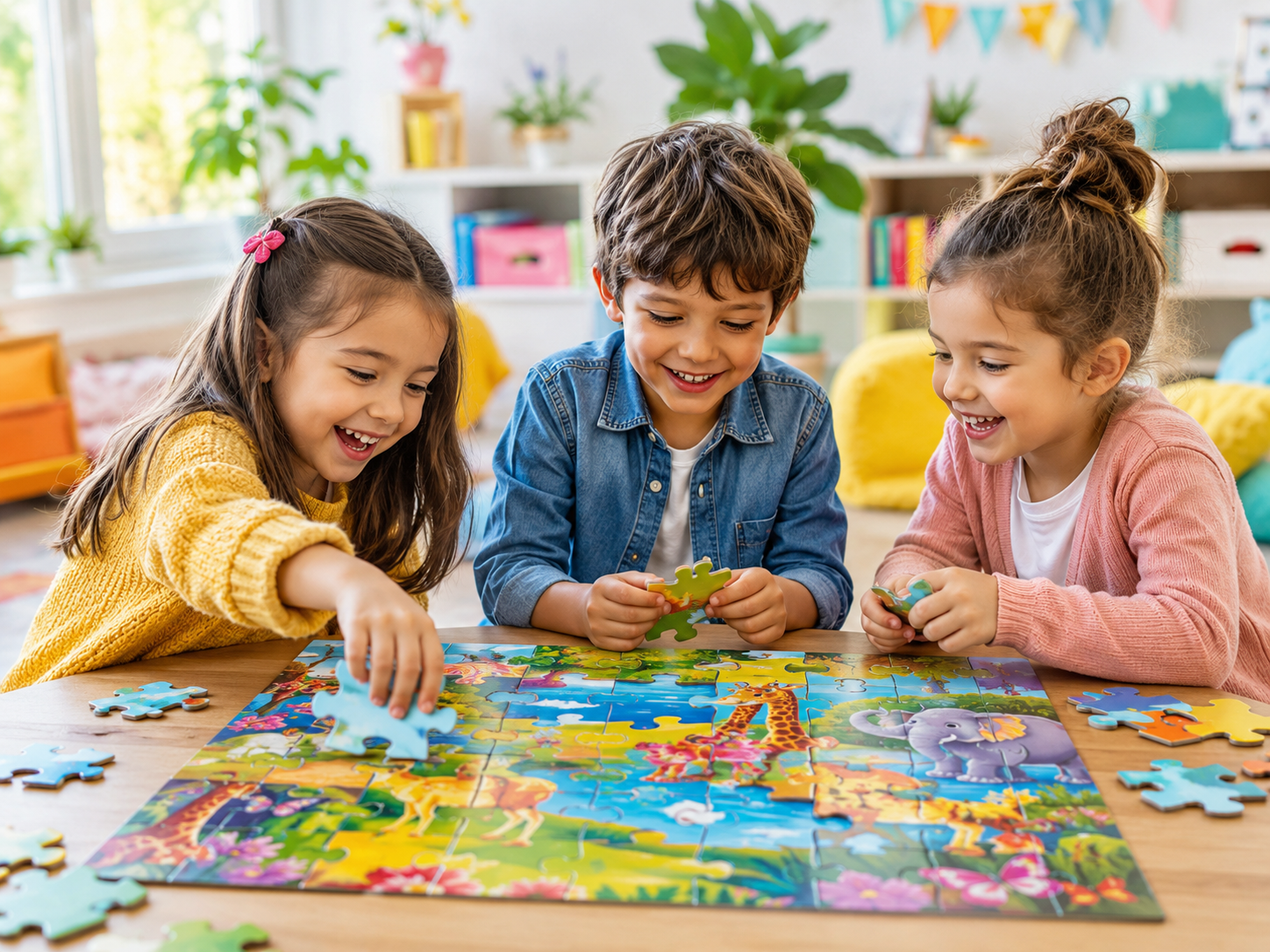
Better for younger kids. Children under about 8 benefit cognitively and developmentally from manipulating physical objects in space. The motor-planning and fine-motor work of fitting actual pieces into actual slots is doing real developmental work. A six-year-old playing a 35-piece puzzle on a tablet is getting a much-reduced version of that experience.
Memory and gift value. A wedding photo turned into a physical 500-piece puzzle delivered to the couple is a different gift from "here, play this online for a few hours and then close the tab." Both can be meaningful. Only one can be unwrapped, finished together at the in-laws' house at Christmas, and then framed.
Better for people with eye strain. Screens cause fatigue most adults underestimate. If you're already doing eight hours of computer work, the last thing you want for relaxation is more screen time. Physical puzzles are restorative in a way digital ones aren't, for this reason alone.
The cost question, honestly
People often frame this as "online puzzles are free, physical puzzles are expensive." That's true if you're looking at a single transaction, but it gets more interesting over time.
A serious puzzler who buys eight physical puzzles a year at $30 each spends $240. The same person on a paid puzzle-site subscription spends $60–120 and gets effectively unlimited variety, plus AI generation, plus the ability to try any photo. Pure cost: online wins.
But you can't display, gift, or rebuild an online puzzle. The $30 physical puzzle has a use life of years. The $10 subscription month is gone in 30 days. Different value model.
The realistic pattern we see: people who fall in love with puzzling start online, where the cost of trying is near zero. Within a few months they buy their first physical puzzle, almost always a custom one of a photo that means something to them. Then they alternate — online for daily play, physical for projects worth keeping.
What the research suggests about cognitive benefits
There's a 2018 randomized controlled trial from Ulm University on the cognitive effects of jigsaw puzzling. It used physical puzzles and found puzzling engages a broad range of visuospatial cognitive abilities. The trial didn't compare digital to physical, so we don't have controlled evidence on that specific question.
The cognitive demands of online puzzles are mostly the same — visual search, mental rotation, pattern recognition. The differences are at the edges: physical puzzles add a fine-motor component, slightly more spatial-tracking-in-3D, and the calming meditative aspect of working with your hands. If you're choosing for general "brain benefits," both work. If you're choosing for a senior parent or someone with dementia, physical puzzles are probably better because the tactile and motor components matter more.
Specific situations and which we'd recommend
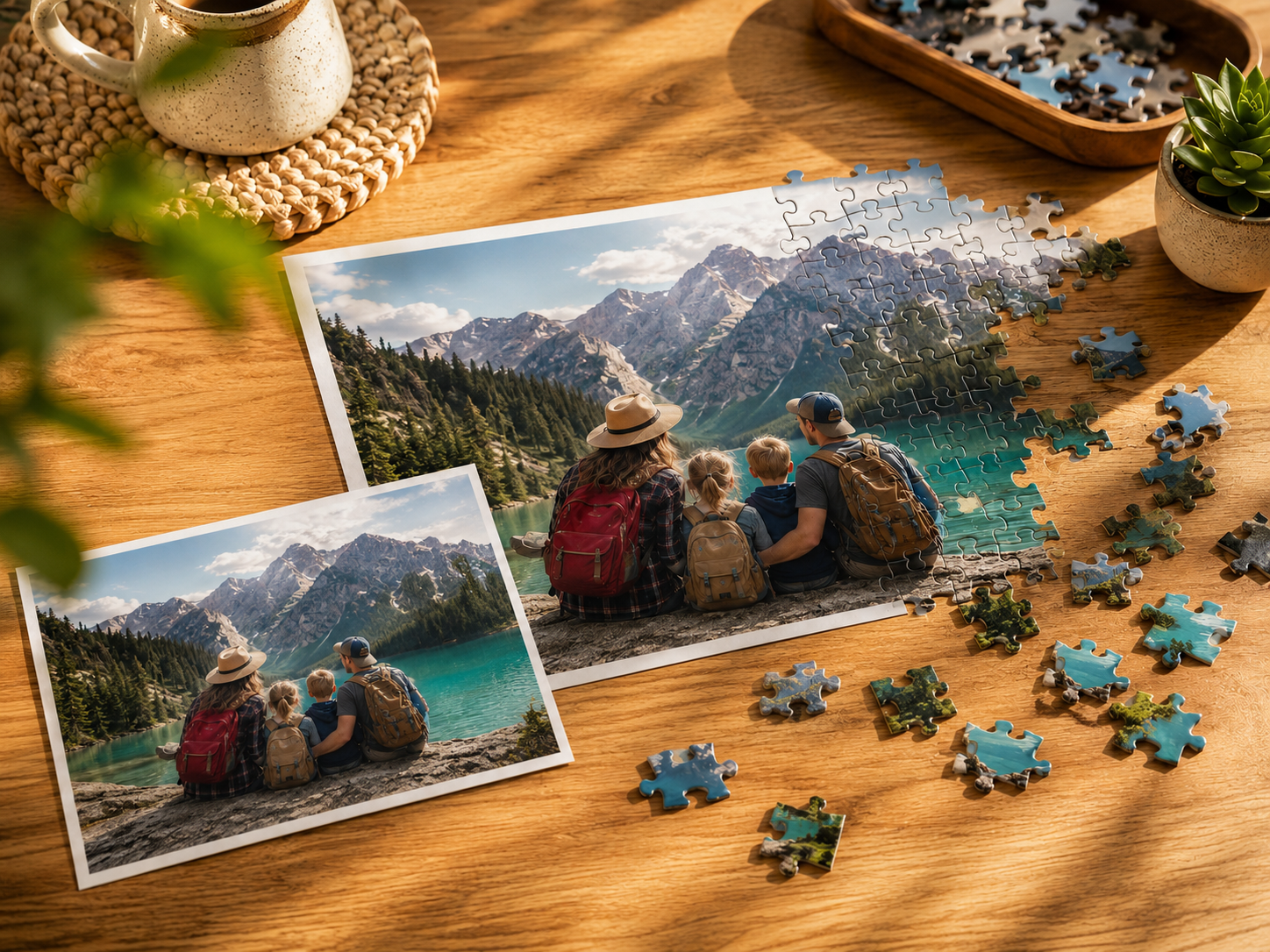
You have a great family photo and want to make something from it. Try it online first to see if it makes a good puzzle. If it does, order the physical version. This is the workflow we built our entire site around because it's how we'd want to do it.
You travel a lot and want a hobby that fits in your bag. Online. A physical puzzle on a plane is misery.
You're trying to get away from screens. Physical. The whole point.
You want to puzzle with your grandkids on a Sunday afternoon. Physical, every time. The shared-table experience is the activity.
You want to puzzle by yourself in bed at 11 pm. Online. There's no good way to do a physical puzzle in bed.
You want a wedding or anniversary gift. Physical custom puzzle of a meaningful photo. Online doesn't deliver as a gift.
You're an adult living in a 30 m² apartment. Online. Physical puzzles need real estate you don't have.
You're a retired puzzler and this is your main hobby. Both. Use online for variety and to keep your skills sharp on quiet days. Buy physical puzzles for the big projects.
You want your kids to love puzzling. Physical at first. Children develop more from physical pieces. Move to online for older kids who already love the activity and want more variety.
You want to try an AI-stylized version of your photo. Online is the only way to do this fast. Once you find a style you love, order it as a physical puzzle.
Where we land
After watching tens of thousands of sessions, our honest take is that the question isn't which one wins, it's which one for what moment. The same person legitimately wants both.
Online jigsaw puzzles solve the problem of "I want to puzzle but I have 30 minutes and no table." Physical jigsaw puzzles solve the problem of "I want a slow, tactile, screen-free afternoon at home, and I want something I can keep." Those are different problems. Trying to make one solve the other is what produces dissatisfaction in both directions — frustrated screen-tired adults forcing themselves through online puzzles they don't enjoy, and frustrated apartment-dwellers buying physical puzzles they never finish.
Pick by the moment, not by the format. Almost everyone who keeps puzzling for years uses both.
FAQ
Are online jigsaw puzzles as good for your brain as physical ones?
The cognitive demands overlap heavily — visual search, mental rotation, pattern recognition are similar in both. Physical puzzles add fine-motor and tactile-spatial components. For general cognitive engagement, both work. For developmental work with kids or therapeutic work with seniors, physical has the edge.
Can I order a physical version of an online puzzle I made?
On our site, yes — if you create an AI puzzle or upload a photo and like the result, you can order the physical version delivered as a real cardboard puzzle. Most other puzzle sites are online-only.
Are online jigsaw puzzles free?
Most sites offer free access with ads. Paid tiers ($5–10/month typically) remove ads, add features like unlimited uploads, AI generation, or cloud-saved progress.
Which is better for kids?
Physical for under-8s — the developmental benefits of handling real pieces are larger. Online works well for older kids who already love the activity and want more variety or to play during travel.
Are physical puzzles becoming obsolete?
No. Physical puzzle sales have grown significantly since 2020 in most markets. The two formats are growing the activity together, not competing for the same time slot.
What's the best online jigsaw puzzle site?
It depends on what you want. Jigsaw Planet has the biggest user-generated catalog. Jigsaw Explorer has the cleanest curation and multiplayer. We (I Love Puzzle) focus on AI photo styling and the option to order physical puzzles of what you played. We've written a full comparison here.
Do online puzzles count as screen time?
Yes, they do. If you're trying to reduce screen exposure, switch to physical for at least some of your puzzling.
Can I do online jigsaw puzzles on my phone?
Yes, all major sites work on phones. The experience is better on a tablet or laptop because more pieces are visible at once, but a phone works for casual sessions.
The next time you sit down to puzzle, the right question isn't online or physical. It's what kind of evening do I want. A slow, screen-free Sunday with a coffee and a partner across the table? Physical. Twenty quiet minutes alone before bed? Online. Both are puzzling. They're just different ways to spend the time.